







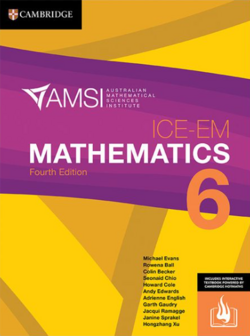
ICE-EM Mathematics Fourth Edition is designed to develop a strong foundation in mathematics for every student in Years 5 to 10.
Developed by the Australian Mathematical Sciences Institute (AMSI), ICE-EM Mathematics helps students master mathematics beyond the curriculum and supports the transition from primary to secondary mathematics.
Beginning at Year 5, the clear instruction and logical topic sequence ensures that students are given the ideal preparation for secondary mathematics and are set up for success in senior courses.
Students are provided with enhanced learning opportunities with fully integrated digital support in the Interactive Textbook.
Print and 1-year digital (code inside book):
This title includes an eBook access code which is found on the inside cover of the Textbook. It is NOT emailed separately.
A free Cambridge Go account is required to access your eBook at www.cambridge.org/go.
We recommend that you check the minimum system requirements for your resource type. For more information on how to use / access your Cambridge digital resource, check the official Cambridge Help Portal.
eBook Duration:
This eBook/interactive textbook is available as a "one-calendar-year subscription". Cambridge defines this as:
• If you activate your code in January to July; one calendar year ends on 31 December of the same year.
• If you activate your code in August to December; one calendar year ends on 31 December of the following year.
Series Features:
- Explicitly meets the requirements of both the Victorian Curriculum 2.0 and the Australian Curriculum v9.0, with additional support mapping the material to the NSW Syllabus and WA Curriculum.
- New curriculum topics include the volume of prisms in Year 7, time zones in Year 8, data sampling methods in Year 9, and logarithmic scales, networks and combinatorics in Year 10.
- Carefully graded exercises and logical topic development caters to a wide range of student abilities and builds students' understanding step by step.
- The new Incorporating algorithmic thinking feature builds intuitive problem-solving skills with flowcharts, function machines and Scratch programming in Years 5 and 6, and Python programming and algorithm design in Years 7–10.
- New First Nations investigations across Years 5-10 are both curriculum-aligned and thoughtfully developed by two respected voices in Australia's First Nations mathematics education.
- New digital tools to help students consolidate their learning include a fully worked solution for every graded exercise question in Years 7-10 (if enabled by the teacher) and a short video demonstration for every worked example across Years 5-10.
- In Years 7-10, extension topics build on the required curriculum content to provide a robust understanding of mathematics and provide excellent preparation for senior secondary courses.
Components:
- Print Textbook
- The text delivered in print format.
- Access Code (found on the inside cover of the Print Textbook)
Activate the 16-character code on Cambridge GO for access to:
PDF Textbook: The downloadable PDF version of the student text enables students to take notes, highlight key passages, and bookmark pages.
Interactive Textbook - 1 calendar year subscription:
The online version of the student text delivers a host of interactive features to enhance the teaching and learning experience of the student text.
The Interactive Textbook is available as a "calendar-year subscription" which is defined as follows:
- if activation occurs between January and July of this year, subscription concludes on 31 December this year.
- if activation occurs between August and December of this year, subscription concludes on 31 December the following year.
Year 6 Table of Contents:
- Chapter 1 Positive and negative whole numbers
- Chapter 2 Addition and subtraction
- Chapter 3 Special numbers
- Chapter 4 Multiplication and division
- Chapter 5 Fractions
- Chapter 6 Fraction arithmetic
- Chapter 7 Decimals
- Chapter 8 Percentages
- Chapter 9 Algebra
- Chapter 10 Length, perimeter and area
- Chapter 11 Volume, mass and capacity
- Chapter 12 Time
- Chapter 13 Lines and angles
- Chapter 14 Shape
- Chapter 15 Maps and coordinates
- Chapter 16 Statistics
- Chapter 17 Probability
- Chapter 18 Incorporating algorithmic thinking
- Answers